AI Disruption is coming for the services Industry first – Here’s the Org Chart that survives It

The narrative is being repeated and recycled and has taken a life of its own, just like all narratives do. You will be replaced by AI or You will be replaced by someone who knows how to use AI. In essence, you’re screwed unless you jump onto the AI bandwagon! The fear mongering will result in everyone learning how to use chatbots and believe that they got the edge against their competitors, be it job market or market share.
Yes, many jobs will be lost just like it happened with every technological transformation. The results will be similar as more jobs will be created than destroyed. Not just more jobs, but more meaningful jobs. This topic is much broader than what can be covered in a blog, but it should kickstart your thinking process.
From workforce hiring -> workforce + AI hiring
Today, we hire people to do various jobs. As the AI ecosystem matures, the industry will need to shift their mindset to hiring not just people but AI as part of the team. The AI may accompany humans as part of the team (ITES Services) or you may hire an AI gig-worker, just like I hinted about ‘software agents’ in an article back in 1999.
I believe that an AI ecosystem will develop that is similar to our educational ecosystem that supplies the workforce of today. This will open up brand new opportunities for the takers.
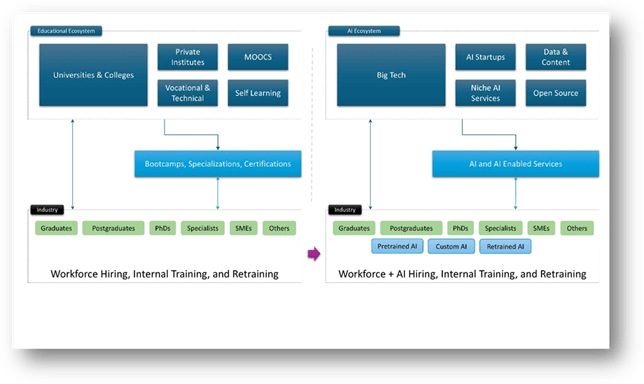
Corporations: This will necessitate reimagining of the corporate structure and hierarchies. Roles like staffing, HR, middle-management, and leadership will need to evolve rapidly. What would be your recruitment and selection process for AI? Will you need the middle-management layer and what would the job profile of these managers if 80% of their team comprises of AI workers? How would you, as a middle-manager, translate the CEO’s vision to actionable items for your human + AI team? What will the org chart look like for such an organization?
Services industry: The largest impact of AI will be on the service industry. Each of the segment in this industry will need to upskill and reinvent their engagement models. The bar for entry level jobs has been raised multi-fold as the LLMs or fine-tuned SLMs may be able to do their job. As the ‘cost-per-token’ decreases for inference and GenAI, it may become cheaper for the industry to hire more AI agents than grad students. The same goes for ITES, where a company like Infosys or Cognizant will be beaten by a competitor who brings a team of humans + AI agents. Research and strategic consulting services like Gartner, Bain and Forrester will face disruption from their competitors who have been early investors in supplementing their workforce with AI research agents.
Job seekers: The first piece of advice I would give to all job seekers is to take some courses in linguistics and get some basic knowledge of what AI is all about. No, you don’t need to learn technical details of how a model is built but you should learn the basics about how data, context window, and prompts can impact the output of an LLM or whatever AI models are applicable to your work domain. Then, experiment with publicly available models to create your own ‘prompt library’ and keep fine-tuning your library as the models evolve.
Opportunities: There are few opportunities that are shaping up that big-tech and others should focus. Companies like OpenAI, Google, Meta and Anthropic, should carve out a separate offering for ‘model distillation’. Similar to how the educational institutes have executive MBAs or focused training modules, the big tech can have this offering that can be used by ITES providers or corporates to create their custom LLMs, SLMs or fine-tune their models.
ITES providers should start building their ‘AI crew’ that can be offered as part of their services to the industry. The service lines can be ‘AI only’, ‘AI + humans’, and ‘Humans only’ with different pricing and SLAs. The same goes for the industry research organizations.
The pace of change in the AI ecosystem is much faster than what we have seen in earlier technological advancements. Early adopters will have an advantage, but a thoughtful strategy will give you a sustained lead amongst your competitors with minimal waste.